
Invoice automation: Boost efficiency and eliminate errors

You need something with a big impact—and a big return on your investment
But it’s hard when your staff is distracted trying to complete their day-to-day tasks. Let our robots free them up to do higher-value work.

The finance team reports that they cut the amount of time spent on processing invoices by around 80% owing to AI-enabled document processing. Now they spend about four hours a week processing invoices, versus the 20 hours a week before the UiPath solution was implemented.
Trevor Dagg
Head of Application Development, Evros Technology Group
Read the case study

White paper
How AI-powered finance automation delivers transformative business value
Financial process automation offers you a way to elevate productivity and optimize workflows, but how can you unlock its full value?
Explore more customer wins in invoice process automation


Case Study
Canon accelerates invoice processing with AI
Learn how Canon achieved about 90% straight-through processing with roughly 40,000 invoices in less than nine months after deploying UiPath Document Understanding.

Case Study
Hudson’s Bay Company transforms purchase order process with automation
HBC has automated over 30 processes, with bots processing 1.5 million purchase orders in just three months. Automation has helped them improve efficiency by validating 17 executive reports daily and submitting over 300 carrier claims monthly.

Case Study
Thermo Fisher Scientific processes 824,000 invoices annually with UiPath
Thermo Fisher Scientific implemented the UiPath Business Automation Platform™ and achieved a 70% reduction in time spent processing invoices. Annually, they handle 824,000 invoices with 85% accuracy and 53% straight-through processing.
Improve invoice processing accuracy by combining automation and AI
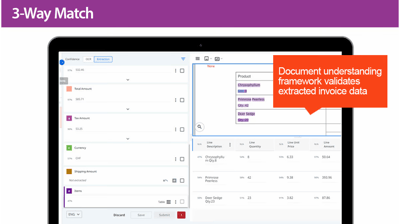
Use UiPath Document Understanding™ to improve your workflows and automate invoice collection, review, and storage. Our robots extract, interpret, and process data for you, even from PDFs, images, handwriting, and scans, reducing turnaround times, and streamlining manual accounting tasks.

Manual invoice collection and storage

Process electronic invoices

Validate and handle invoice data

Submit transactions for processing

Manage matching discrepancies


Blog
DocPath: A large language model for information extraction from documents
Learn how this groundbreaking specialized LLM practically eliminates model training for document processing.
Prebuilt invoice automations help you uncover inefficiencies faster
Visit the UiPath Marketplace to see all the prebuilt automations and connectors that are ready to help you make a difference today.

Marketplace Component
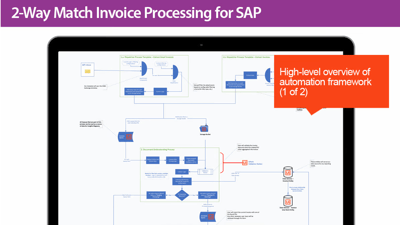
2-way match invoice processing for SAP
Vendor invoice straight-through processing using Document Understanding.
Marketplace Component
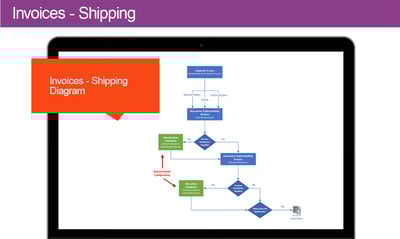
Invoices - Shipping
Out-of-the-box machine learning model for seamless processing, retrieval, and validation of shipping invoices.